
Transform your outdoor space with custom hardscaping services in Monmouth County, NJ. GreenGrove Outdoors designs and installs patios, walkways, retaining walls, fire features, outdoor kitchens, and premium hardscape solutions that enhance property value and outdoor living.
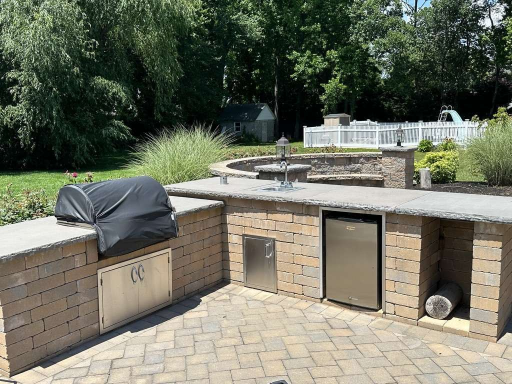
Hardscaping creates the foundation of an outdoor environment. From elegant patios to functional retaining walls, professionally designed hardscape features add beauty, structure, and usability to residential and commercial properties. At GreenGrove Outdoors, we specialize in creating custom hardscape solutions that blend seamlessly with surrounding landscapes. Every project is designed to complement your property while providing durability and long-term performance. With over 40 years of landscaping and outdoor construction experience, our team delivers premium craftsmanship and attention to detail on every hardscaping project.
GreenGrove Outdoors proudly provides hardscaping services throughout Allenhurst, Allentown, Asbury Park, Atlantic Highlands, Avon-by-the-Sea, Belmar, Bradley Beach, Brielle, Eatontown, Englishtown, Fair Haven, Farmingdale, Freehold, Highlands, Interlaken, Lincroft, Little Silver, Long Branch, Manasquan, Matawan, Middletown, Monmouth Beach, Neptune City, Oakhurst, Ocean Grove, Oceanport, Ocean Township, Port Monmouth, Port-au-Peck, and Red Bank.
Custom patios designed for outdoor entertaining, relaxation, and increased property value.
Beautiful pathways that improve accessibility and enhance landscape aesthetics.
Engineered retaining walls that improve drainage, prevent erosion, and create usable outdoor spaces.
Create inviting gathering spaces with custom fire pits and outdoor fireplaces.
Expand your outdoor living experience with fully functional cooking and entertainment areas.
Premium stonework and landscape accents that add character and sophistication.
Almost every failed patio in New Jersey fails from underneath. The pavers themselves are rated for far more abuse than they will ever see; what moves is the ground beneath them. A hardscape that is still flat and tight ten winters from now is one where the excavation, the base and the drainage were designed for local conditions before a single stone was set.
Under a finished paver surface sits a compacted aggregate base — typically four to six inches for a patio or walkway carrying foot traffic, and considerably more where vehicles will ride over it. It is built up in three- to four-inch lifts, each compacted separately, because a single deep layer compacts only at the top and settles later. On heavier soils we separate subgrade from base with a geotextile fabric so the two never mix and pump into one another. Above the base goes a screeded one-inch bedding course — no thicker, since a deep sand layer behaves like a cushion and lets pavers rut. The perimeter is locked with an edge restraint and the joints are filled with polymeric sand, which stiffens the field into a single interlocked surface. None of this is visible when the job is done, and all of it is what separates a patio that lasts from one that needs relaying in five years.
Monmouth County does not simply get cold — it crosses the freezing point back and forth dozens of times between December and March. Every one of those cycles expands whatever water is trapped in the base and lifts what sits on top of it. That is why drainage matters more here than raw material strength. We pitch finished surfaces away from the house at roughly an eighth to a quarter inch per foot, use free-draining base material rather than material that holds water, and give that water somewhere to go once it reaches the edge. Where a fire feature, an outdoor kitchen counter or a freestanding wall needs a footing, the footing has to reach below the frost line; your municipality’s building department sets the depth that governs, and in this part of the state it is typically around thirty inches.
Monmouth sits on the Atlantic coastal plain, and the ground is not the same at both ends of it. Toward the shore — Belmar, Manasquan, Avon-by-the-Sea, Bradley Beach — the soil tends to be sandy and drains quickly, which is a gift for a paver base. Move inland toward Freehold and Englishtown and it gets heavier, with more silt and clay that holds water and heaves harder in winter. The same patio detail is not correct in both places, so we dig test holes and look at what is actually there rather than assuming.
Within a mile or so of the water, salt spray is a real material consideration. It accelerates corrosion on any exposed metal fixing and leaves deposits that are easily mistaken for efflorescence. Stainless or hot-dip galvanised hardware, and a finish that can be rinsed rather than one that traps deposits, both age better in the shore towns than the equivalent inland specification.
The material question usually comes down to concrete pavers or natural stone. Both work here. They cost different amounts and they age differently, and the honest answer depends on the property.
Manufactured pavers are dimensionally consistent, which makes patterns crisp and installation predictable, and they are produced specifically to survive freeze-thaw. Their real advantage shows up years later: because the surface is modular and sand-set rather than bonded, a single damaged unit can be lifted and replaced without a visible patch, and a section disturbed by a tree root can be taken up, re-based and re-laid using the same stone. The colour range is the widest of any option, and current textures do a convincing job of reading as quarried stone.
Bluestone is the traditional choice across New Jersey and it still looks like nothing else. It comes thermal — sawn to a uniform thickness with a flamed, lightly textured face — or irregular, hand-fitted with wider joints for a softer, older look. Natural stone runs cooler underfoot than dark concrete in August, which matters on a south-facing patio, and it carries a price premium and more layout labour, particularly for irregular work. Colour varies piece to piece, which is rather the point of it.
A poured concrete slab is a single rigid plane sitting on ground that moves every winter. When it cracks — and in this climate it eventually does — the crack is permanent and any repair is visible. A paver field is thousands of small pieces with flexible joints, so the same ground movement is absorbed across the whole surface instead of concentrating into one fracture. That is the main reason we build patios, walkways and seating areas this way.
Efflorescence. A white or grey haze sometimes appears on new concrete pavers in the first months. It is mineral salt migrating out of the paver as it cures, it is not a defect, and it weathers off on its own within about a year. It can be removed sooner with a cleaner made for the purpose, but it should not be attacked with a pressure washer, which strips joint sand and scars the surface.
Joint sand. Expect to top up joints occasionally in the first couple of seasons, particularly along edges and anywhere water runs off a roof.
Sealing. Optional. A sealer deepens colour and makes spills easier to lift, and it needs redoing every few years. An unsealed patio is not a neglected patio.
Winter. Use a plastic-bladed shovel rather than steel. Rock salt is hard on new concrete and on whatever it washes into — sand for traction, or a calcium- or magnesium-based de-icer, is the better choice, especially through the first winter.
Hardscaping rarely stands alone. A new patio changes where water goes, which puts it in the same conversation as drainage; and the planting around it is what makes it look settled rather than installed, which is landscape design and installation. Finished projects across the county are in our project gallery.
We work mainly in concrete pavers and natural stone, with bluestone the most common stone choice in this area. Concrete pavers come in a consistent thickness and interlock as a unit, which is what lets a patio flex with the ground instead of cracking, and a damaged one can be lifted and swapped without disturbing the rest. Bluestone gives you natural color variation and can be laid as sawn rectangles for a formal look or irregular for something softer. Both are set on a compacted aggregate base rather than poured concrete.
It depends on the municipality and on what the work touches. A patio laid at existing grade often does not require a building permit, but towns set their own rules, and anything that changes grading, drainage, or the amount of impervious coverage on a lot can pull the project into review. Retaining walls commonly cross a permit threshold around four feet of exposed height, and engineered drawings may be required at or above it. Your local construction office is the authority, and we confirm before anything is dug.
Separately, a New Jersey 811 markout is required by law before any excavation regardless of permits, and it takes three business days to clear.
Almost always the base underneath, not the pavers themselves. Water sitting in a base that was not compacted properly, or that does not drain, freezes and expands and pushes the surface up. When it thaws it leaves a void, and the pavers settle unevenly into it. New Jersey runs through dozens of freeze and thaw cycles in a single winter, so a base that would be perfectly adequate in a milder climate fails here. A base built in thin compacted lifts that sheds water, with edge restraint holding the field tight, is what prevents it.
A wall can redirect surface water and stop a slope from eroding, but the more useful way to think about it is that drainage is what keeps the wall standing. Soil holds a great deal of water, and saturated soil behind a wall pushes on it with far more force than dry soil does. That pressure is the most common reason walls lean, bulge, or fail outright. Clean crushed stone backfill and a drain line at the base of the wall give that water somewhere to go, which is why they matter more than the blocks you can actually see.
Yes, both are part of what we build. The detail that matters most here is the foundation. A masonry structure carrying real weight cannot sit on the same base as a patio; it needs a footing carried below the frost line so that ground freezing underneath it does not lift and crack it. Counter runs, grill surrounds, seating walls, and fire features are all designed around that. Gas and electrical connections are permitted and inspected work, and they get planned in before the base goes down rather than chased afterward.
Efflorescence. Concrete pavers contain soluble salts left over from the cement, and as the paver cures, water carries them to the surface and evaporates, leaving a white or gray film. It looks alarming on a patio that is only a few weeks old. It is not damage, it does not weaken anything, and it normally weathers away on its own across the first year or two as rain rinses it off. Resist the urge to attack it with a pressure washer or an acid wash early, because both can etch the surface and leave a permanent mark exactly where the haze would have faded on its own.
Most of the year works. The practical limit is frozen ground, since you cannot excavate or compact a base properly once it is frozen, so deep winter is out. Spring is the busiest season and also the wettest, and saturated soil makes clean base work harder. Late summer and autumn are usually the easiest time to get scheduled, and drier ground gives more predictable compaction. If you want a patio for next summer, planning it the autumn before tends to go more smoothly than calling in May.
Skip the rock salt. Sodium chloride is hard on concrete pavers and accelerates surface scaling across repeated winters. Calcium chloride or magnesium chloride is gentler, and plain sand adds traction with no chemistry at all. Use a plastic shovel rather than a metal one so you are not chipping edges.
The other thing worth staying on top of is the joints. Joint sand is what transfers load from one paver to the next, and once it washes out, individual units start to rock and the surface loosens from there.
A typical residential patio is a few days to about two weeks of on-site work, though the calendar is usually longer than the labor. The three business day markout has to clear before anything is dug. Excavation depth drives much of the rest, because a base sized for the soil on your property can mean moving considerably more material than the finished patio suggests. Access matters too: a yard a machine cannot reach is a yard where material moves by wheelbarrow. And weather sets the pace at the base stage, because a saturated base cannot be compacted and waiting is better than building on it.